Context
For laptop repair, PC service, Wi-Fi or data recovery, customers need a fast answer. The page must clearly show services, phone number, local area, form and the next steps.
Prelanding for PC/laptop service in Chisinau, connected with CRM for Google Ads and Facebook Ads.
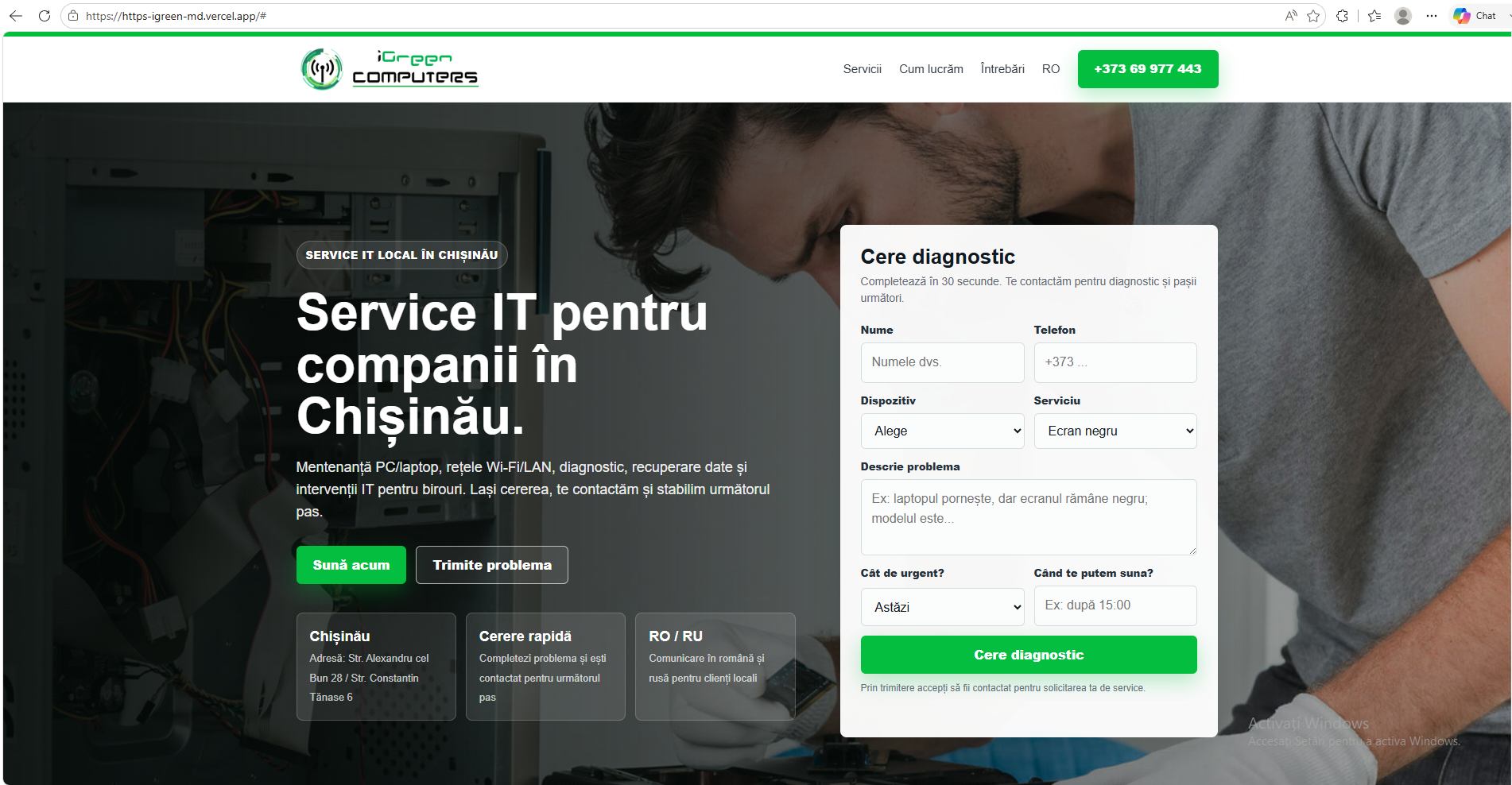
iGreen Computers is a live local IT service project: conversion prelanding plus CRM for leads from Google Ads and Facebook Ads. The page collects diagnostics requests, calls and client details, while the CRM helps verify source, status and request quality.
Status
Live
Format
Prelanding
Channels
Google + Meta
CRM
Ads leads
For laptop repair, PC service, Wi-Fi or data recovery, customers need a fast answer. The page must clearly show services, phone number, local area, form and the next steps.
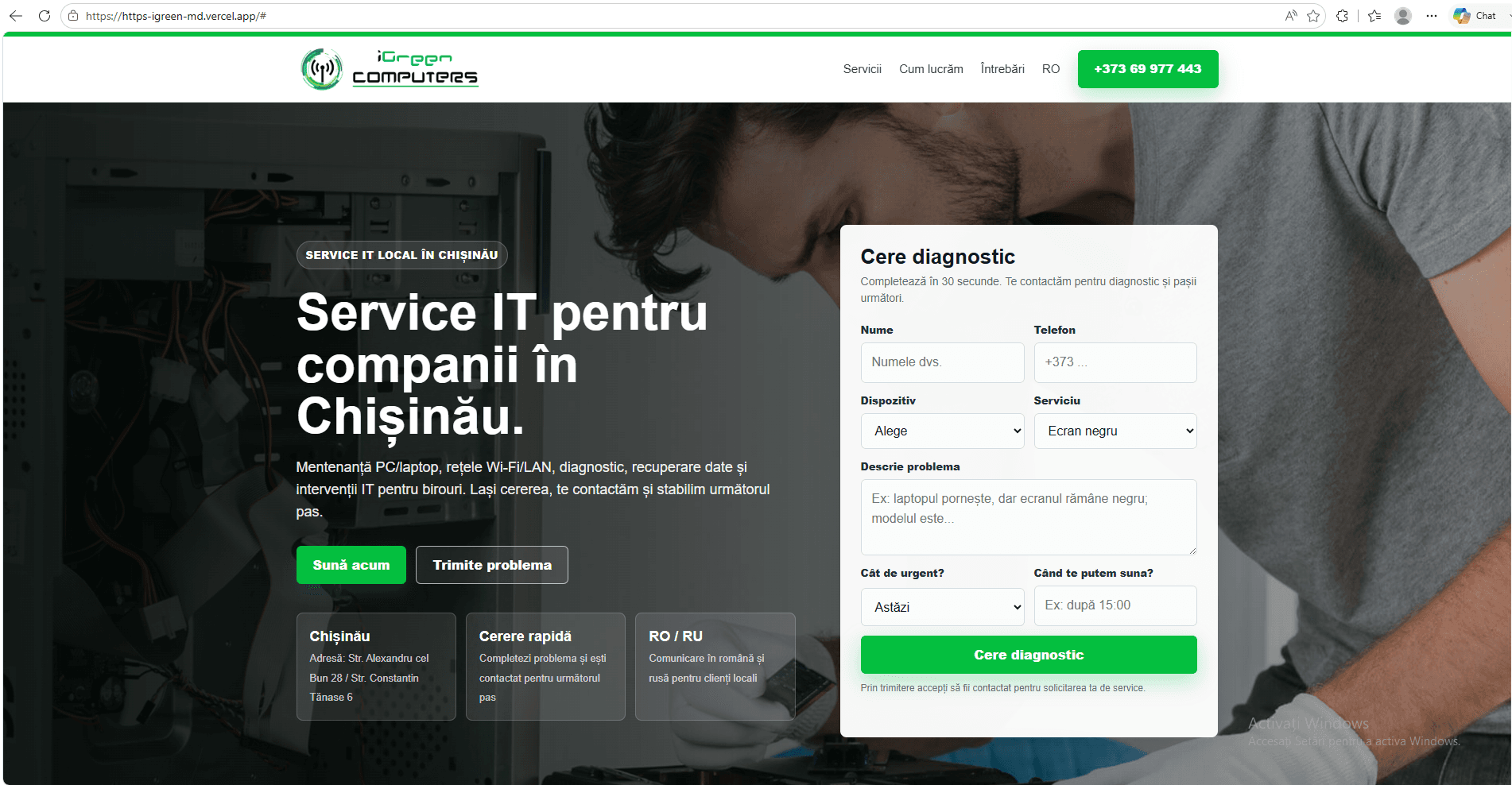
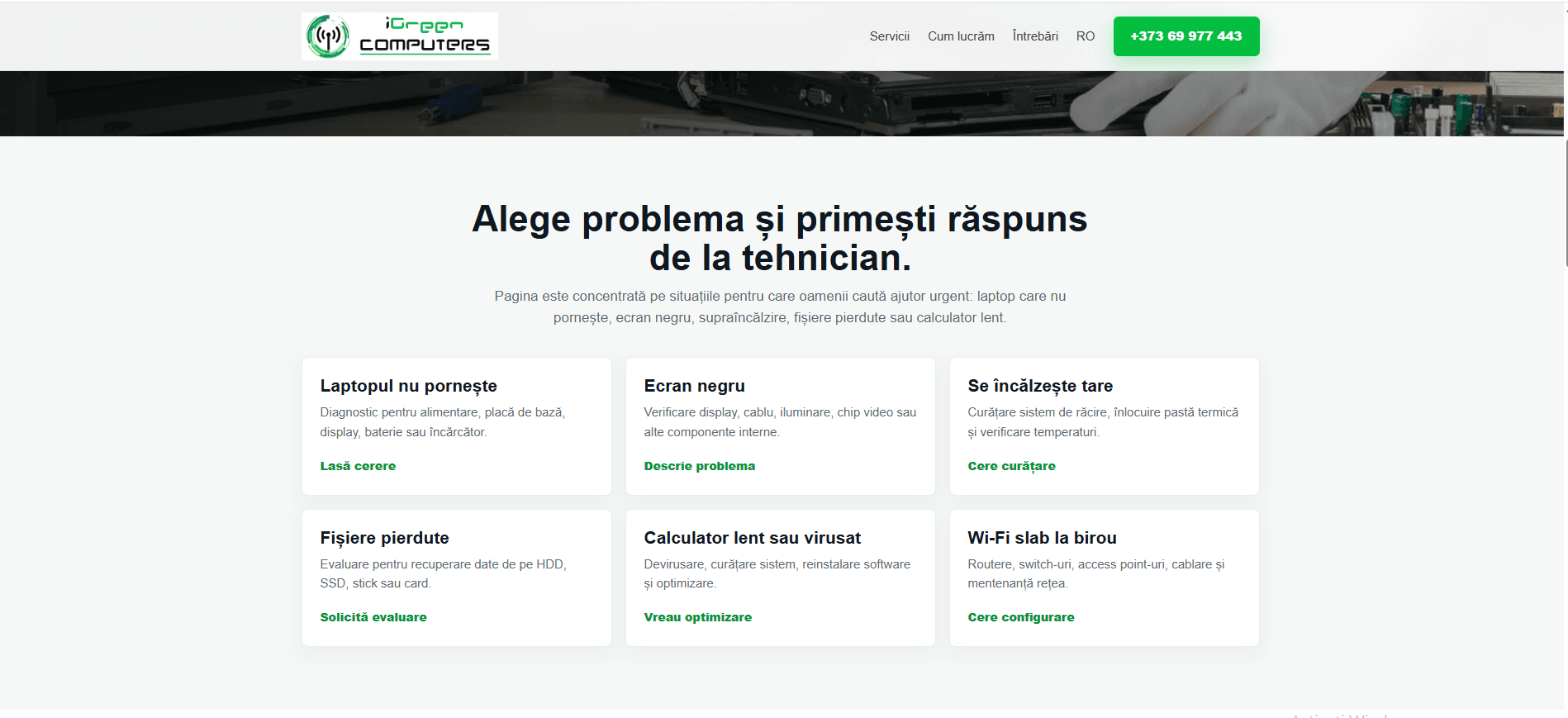
We created a fast prelanding with strong hero, short form, frequent problems, call CTA and tracking for paid campaigns. Behind it, the CRM can separate leads by source, status, phone, notes and verification stage.
Google Ads captures repair intent, Facebook Ads supports local demand, and the CRM shows which source brings real requests. The model becomes easier to optimize for CPA and qualified leads.
Google Ads captureaza căutări active. Facebook Ads creeaza cerere locală. Landing page-ul transformă traficul în cereri măsurabile.
Conversion prelanding for IT service in Chisinau
CRM for leads from Google Ads and Facebook Ads
Fast diagnostic form for qualified requests
Tracking for phone, form, CTAs and ad source
Google Ads structure for high-intent searches
Facebook Ads campaigns for local demand and remarketing
We can build the landing page, tracking and Google/Facebook Ads campaigns for local services with a clear objective: requests, calls and measurable leads.
Request offer on WhatsAppExtended case study
Pre-landing and CRM for Google Ads and Facebook Ads. We examine the decisions that transformed the initial requirement into a usable product for individuals and companies from Chisinau looking for local IT services.
Open the iGreen pre-landing01 · Executive summary
For iGreen Computers we built a pre-landing dedicated to Google Ads and Facebook Ads campaigns, connected to a CRM flow. The page does not attempt to reproduce the entire company website. It responds to the immediate intent of the person looking for PC or laptop repair, data recovery, cleaning, de-virus, upgrade or networking and directs them to the call or form.
The project primarily serves individuals and companies from Chisinau looking for local IT services, within the market context of Chisinau and the Republic of Moldova. The evaluation therefore goes beyond the visual appearance of the first page. A strong digital product must explain the offer, guide the user toward an appropriate action, keep information accessible on mobile devices, and remain manageable after launch. These criteria shaped the architecture, content, and implementation order.
The primary objective was to turn ad traffic into measurable and manageable requests. To achieve it, we treated the website as part of a system: public pages establish context, forms and actions capture intent, and the tools behind them organize follow-up. Every section therefore has a verifiable purpose. It does not merely fill space; it answers a real user question or removes an unnecessary step from the process.
02 · Context and strategy
Paid traffic needs continuity between keyword, ad and page. Sending the user to a general site would have added options and distractions. The project needed to delineate services, build trust quickly and provide enough data for the team to track each request.
The first step was to separate mandatory requirements from ideas that could be added later. We mapped the audience, important actions, content types, languages, data requirements, and administration model. This analysis prevented the creation of an attractive page that would be difficult to extend. It also clarified what should remain public for indexing, what belongs in a private flow, and what information should be stored in the CRM or administration panel.
We separated the pre-landing on the ads.igreen.md subdomain and kept the message conversion-oriented. This structure allows content to be changed and campaigns tested without destabilizing the main site. The CRM provides a common destination for forms and calls, so performance isn't just measured by clicks.
The strategy followed a simple order: users first understand where they are, then what they receive, why the solution is relevant, and what to do next. Trust elements were placed close to the decision instead of being hidden on a secondary page. Detailed information received its own level in the hierarchy, keeping the first screen focused while remaining available to people who compare offers carefully.
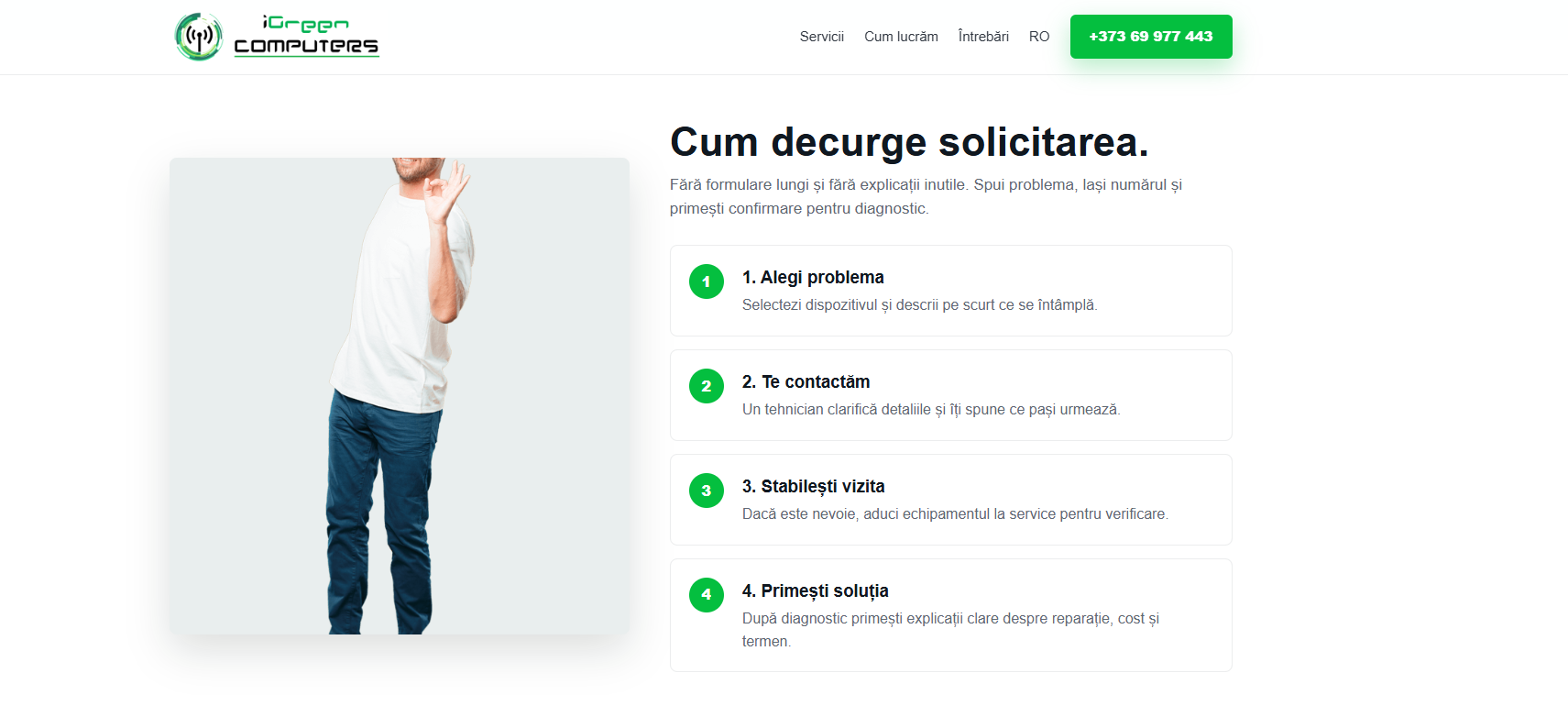
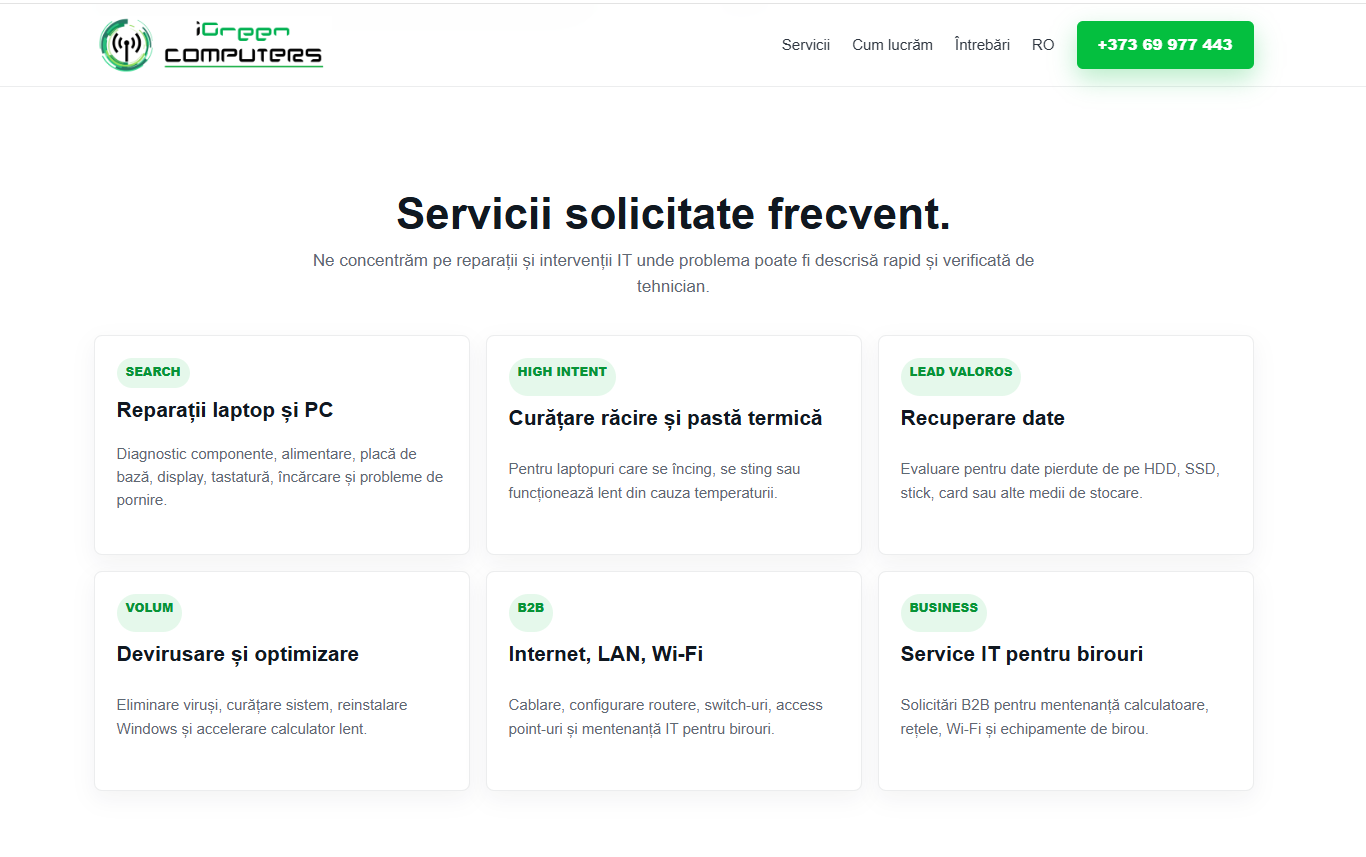
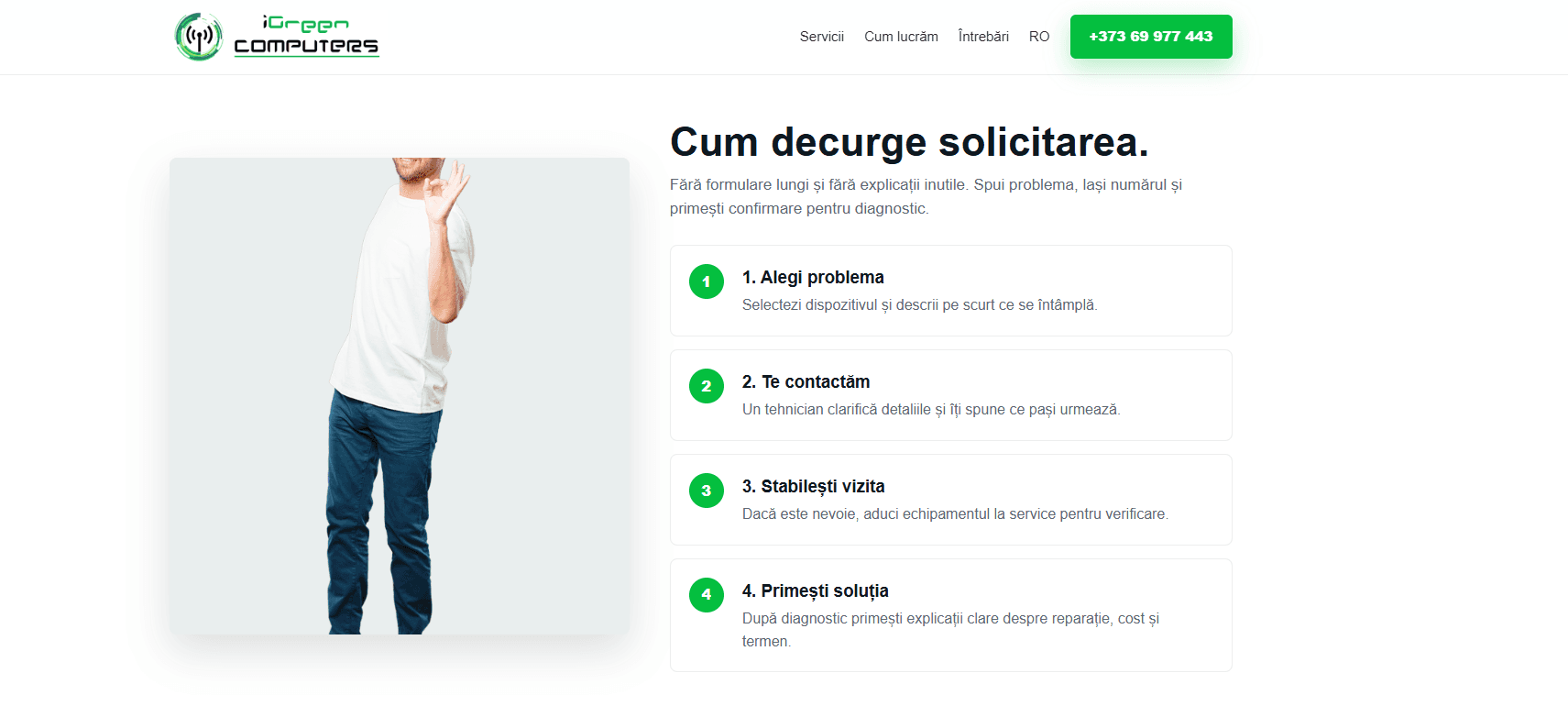
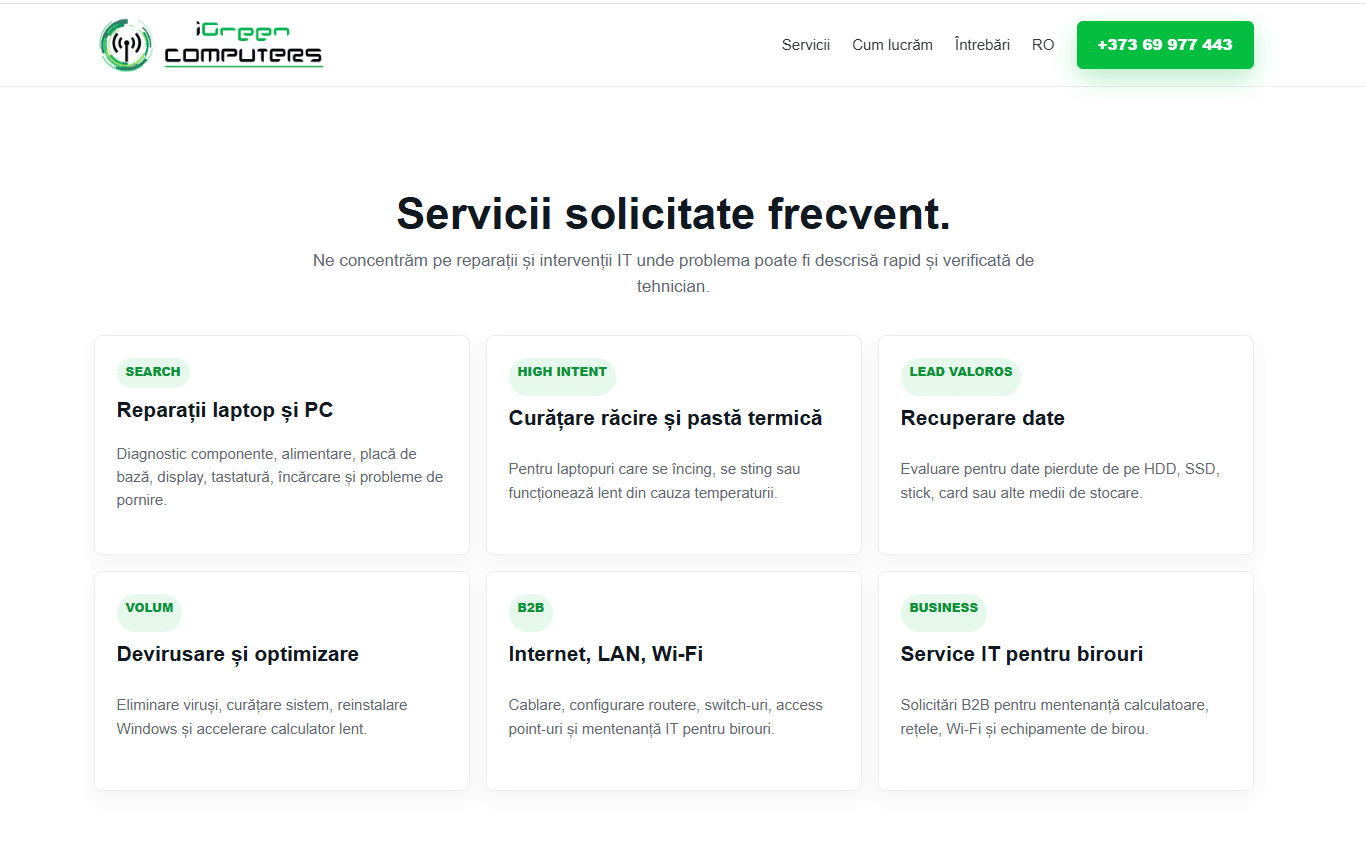
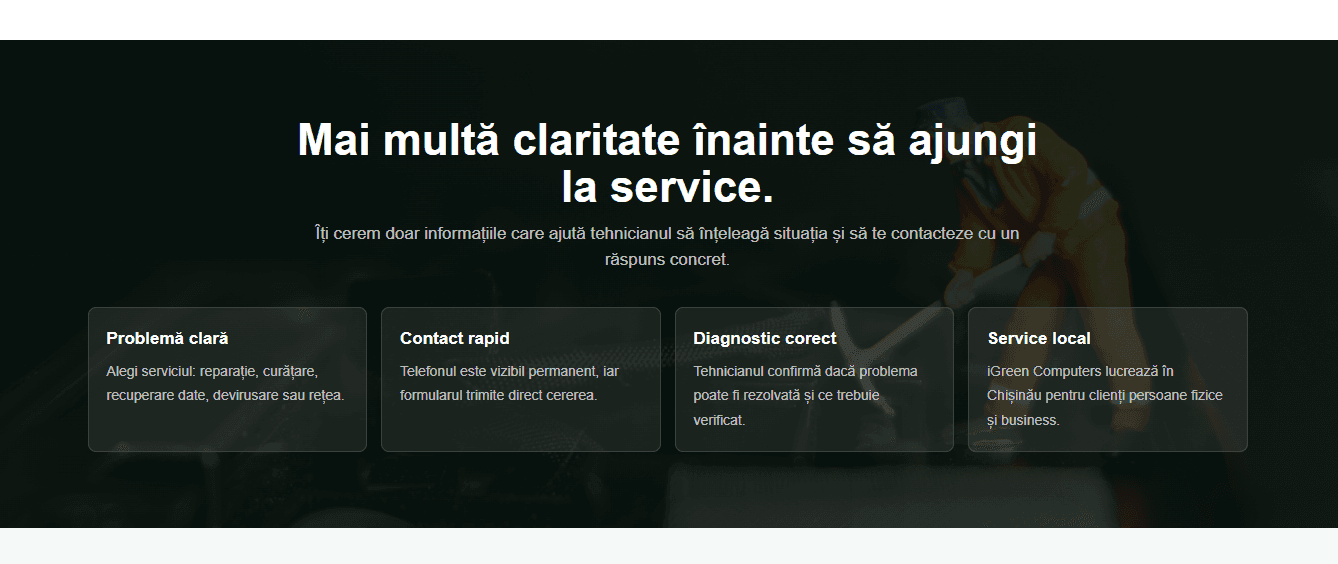
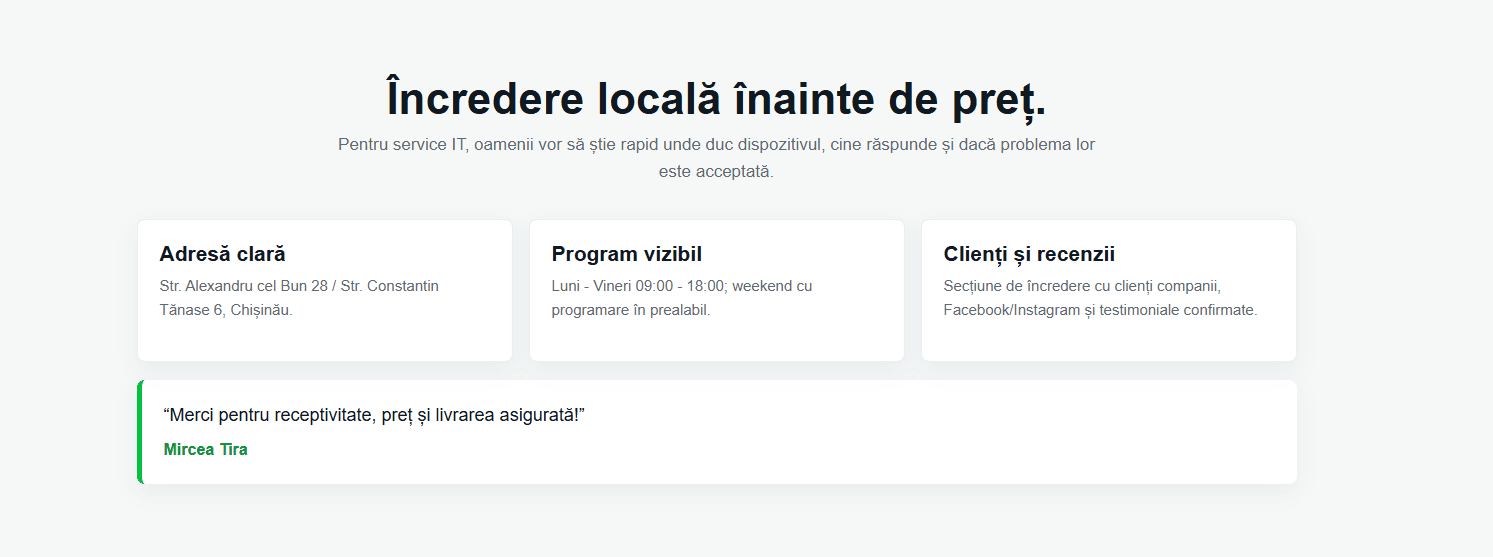
The order of the page follows the client's questions: what services are available, why they can trust, how the intervention is carried out and how to ask for help. The Issues, Services, Process and Clarity sections make the same promise. CTAs are repeated contextually, not mechanically.
Information architecture has been validated through trails, not just through a list of pages. I've been watching what happens if the visitor goes straight from Google to an inside page, comes back from his cell phone, or ends up in an ad with a precise intention. Each route maintains access to context, offer and contact without forcing the user to manually return to the main page.
03 · Implementation
Implementation was divided into modules with clear responsibilities. This approach reduces dependencies between pages, allows targeted updates, and helps the team test important functions without blocking the entire product. Visual components follow shared rules, while content and user journeys are adapted to the project instead of being copied mechanically from a template.
The page promise continues the intent of the ad and avoids unnecessary navigation.
Repairs, data recovery, upgrades and networking are presented separately.
Forms and feeds are organized into a measurable CRM flow.
The call and request are visible at times when the user has sufficient context.
At the technical level, we paid attention to intermediate states: loading, error, confirmation, empty results, and returning to an unfinished flow. These situations are common in real use even though they rarely appear in static mockups. Messages and controls were designed so users understand what happened and can continue without immediate support.
Content was treated as part of the product. Headings explain the decision at hand, paragraphs use concrete examples, and buttons clearly name the action. We avoided generic wording that promises a great deal without explaining the deliverable. In a case study, this clarity is as important as the technology because it shows what was implemented and why the solution fits the project's audience.
04 · Experience and Conversion
A visitor can call or submit a request. Campaign parameters and source can be kept in CRM and the team sees the lead path. This allows the separation of real requests from mere traffic and provides a basis for optimizing ads and search terms.
The conversion route was designed around intent, not a single button. Early people need explanations and examples, while determined visitors seek price, contact or direct action. The page keeps both variants, but sets a clear visual priority. Secondary actions do not compete with the main action and contact remains accessible without aggressive windows.
The forms only require the data required for the relevant stage. An initial application should not be converted into a long questionnaire and an order should not be left without the information the team needs to reply to. Confirmation explains the next step and estimated time. This continuity reduces repeated messages and sends that the process is administered, not improvised after sending the form.
On mobile, the phone and form get priority, and texts are split into short blocks. The visuals don't push the main action under a very long screen. Button sizes and section order are designed for one-handed use.
On mobile, the order of content has been revised separately. I didn't just shrink the desktop version. Titles, images, buttons, lists and spaces have been reorganized for one-handed reading. Interactive areas have stable dimensions, the text is not hidden in rigid containers, and long sections retain visible landmarks. For individuals using keyboard or assistive technology, labels, hierarchy of titles and focus states retain the meaning of actions.
05 · Discovery and data
The pre-landing has a clear local theme and describes IT services without artificial clutter of keywords. The title, description, and content support local intent, and the link to the parent domain preserves the company's identity. The page is useful for both paid traffic and direct hits.
The search optimization starts with a structure that the user can understand. Each important page has a main subject, descriptive title, description and links to the pages that complement the intention. The images have stable dimensions and descriptive alternative texts, and the addresses of the pages are kept simple. Canonical, sitemap and rules for crawlers support the same architecture and avoid indexing technical states, filters or private pages.
Internal links are used editorially: they explain the relationship between the project and the services that made it possible. External links send to the public product and verified sources, allowing the reader to compare the description with the actual implementation. We don't use an artificial list of keywords. The context, correct names and verifiable information are more useful for both humans and search engines.
Measurement tracks lead source, campaign, form, call and status. The central indicator is not isolated CTR, but the cost of a valid request and its progress in CRM. Reporting can separate services that produce volume from those that produce higher value projects.
Measurement is defined before reporting. Visits, scrolls and clicks are user indicators, but they are not automatically a business result. For each project, actions that have value are tracked: requests, calls, orders, access to a function or return. Events are consistently referred to so that data can be compared between pages and periods without different manual interpretations from one relation to another.
Content can be adjusted according to actual customer queries and questions. Independent sections allow testing of messages, and the CRM maintains the same logic when a new campaign or service is added.
The launch does not complete the project. It is necessary to check forms, update information, monitor errors, review dependencies and regularly control indexed pages. The roles and rights of access limit accidental changes and safety copies and history of changes reduce operational risk. A modular structure allows expansion without affecting routes that already operate.
These links provide additional technical context and describe the supplies used in implementation.
06 · Verifiable Gallery
The screenshots below document the project; they are not decorative images. Each one can be opened at a larger size to inspect the hierarchy, content, and interface details. The gallery is placed beside the technical explanation so readers can verify the connection between the decisions and the visible result.
07 · Conclusions
The most important conclusion is that a digital product should not be assessed as a collection of screens. Its value lies in the connection between the message, interaction, data, and the process that follows contact. For iGreen Computers, this link was built from the specific needs of the segment individuals and companies from Chisinau looking for local IT serviceswithout forcing the project into a universal structure.
The second conclusion is that visible simplicity requires work in architecture. For a user to see few clear choices, the system must manage pages, states, roles, content and measurement correctly. This complexity must not be transferred to the interface. It is organised behind and progressively revealed only when it becomes relevant.
The analysis was confronted with available public pages. The links below are provided for direct verification and additional editorial context.
08 · Frequently Asked Questions
Because iGreen Computers serves individuals and companies from Chisinau looking for local IT servicesand this audience has its own path, language and confidence criteria. A template can speed up prototyping, but it cannot decide on its own what information to publish, what action is priority, how to keep the context between pages or how to measure the result. The final structure was built from the requirements of the project, then visually unified through reusable components.
The important flows have been reviewed at different sizes, carefully in the order of content, the size of the pressing areas, legibility, images and forms. The mobile is not a small copy of the desktop. Some elements change order, the lists are simplified and the main proceedings remain available without covering content or other checks.
It means that public pages have clear topics, titles and own descriptions, semantic hierarchy, descriptive images, internal links and stable addresses. The sitemap, canonicals and indexation rules support the same structure. SEO is not a promise of position, but the technical and editorial capacity of the site to be discovered, understood and evaluated correctly by search engines.
The modules are separated so that iGreen Computers be able to receive new pages, functions, integrations and content without complete reconstruction. Expansion starts with user data and actual customer questions. New functions are prioritised by impact, dependency and cost of administration, not just by the fact that they can be technically added.
The availability of pages, errors, forms, relevant actions, speed and navigation behaviour shall be monitored. The data shall be interpreted in relation to the objective of the project. If a page attracts traffic, but does not lead to useful action, the message, information order and supply shall be reviewed before increasing the promotion budget.