Context
Many small businesses în Moldova hear about AI but do not know how to turn it into concrete results. The product needed to be local, clear and multilingual, explaining the next step and turning a conversation into useful business actions.
AI platform for local businesses in the Republic of Moldova
AI Moldova is an ADS Moldova-owned project created to help local entrepreneurs use artificial intelligence in real work: consulting, documents, images, marketing, plans and recommendations connected to executable services.
Status
Live
Languages
RO / RU / EN
Capabilities
10+
Owner
ADS Moldova
Many small businesses în Moldova hear about AI but do not know how to turn it into concrete results. The product needed to be local, clear and multilingual, explaining the next step and turning a conversation into useful business actions.
We built an AI platform with its own identity, premium interface, RO/RU/EN support and workflows designed for local business. Chat is the entry point, while the output can become a brief for Google Ads, local SEO, websites, social media, automations or creative materials.
The platform is live at aimoldova.md and positions ADS Moldova as a team that does not only use AI, but builds AI products for the local market. The project becomes an education, lead generation and differentiation channel.
aimoldova.md is built as a owned product, not just as a presentation page.
AI Moldova branding, optimized logo and favicon
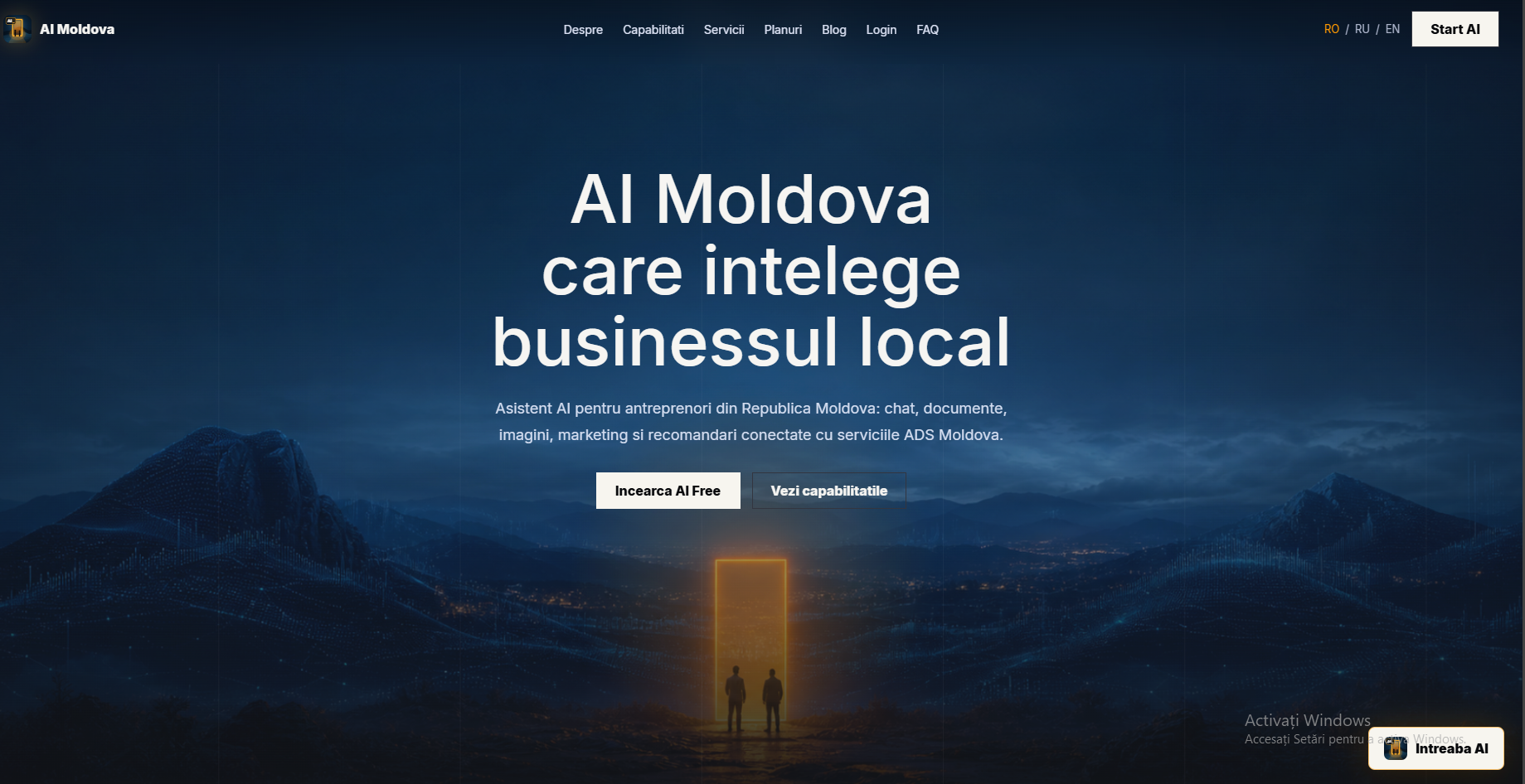
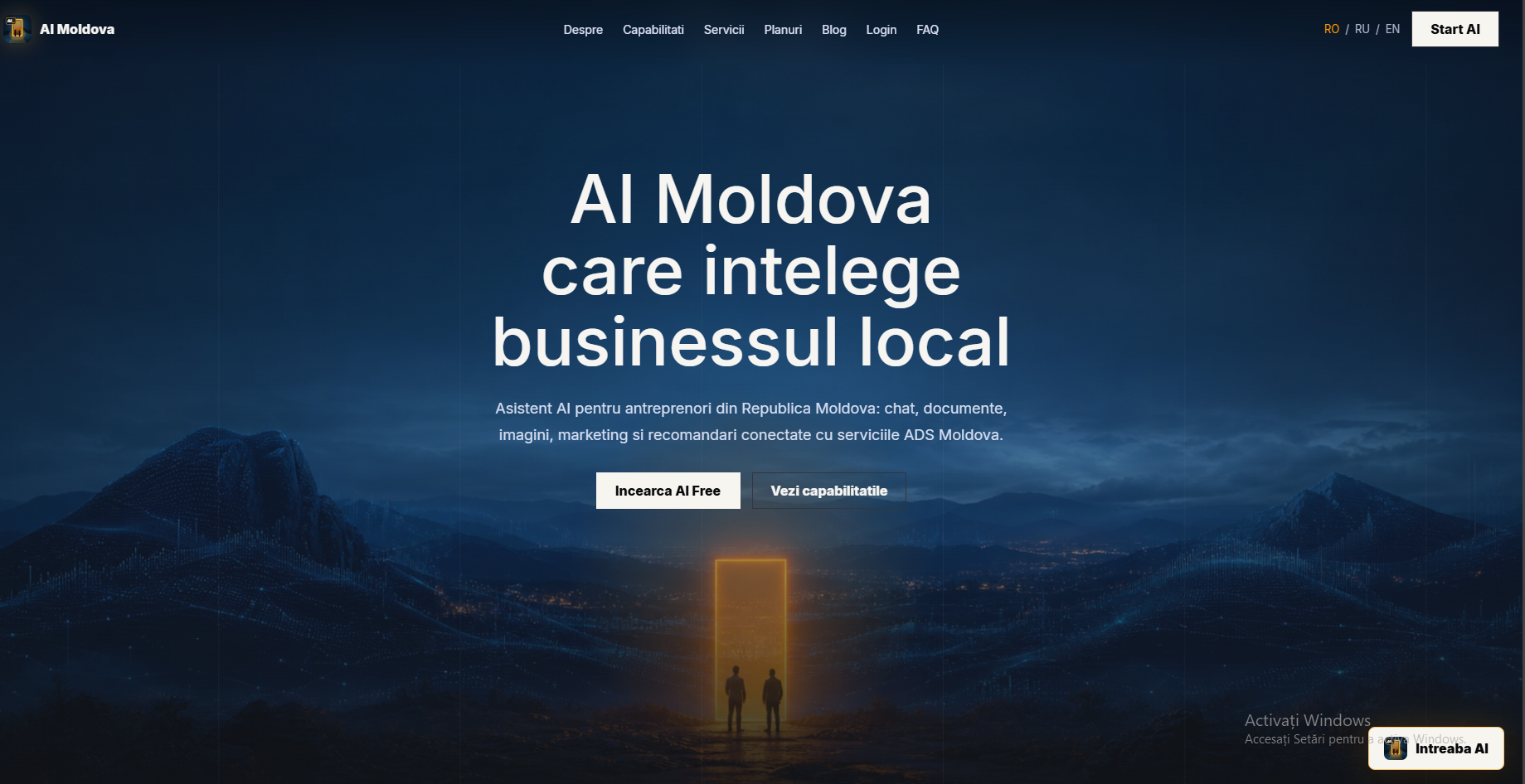
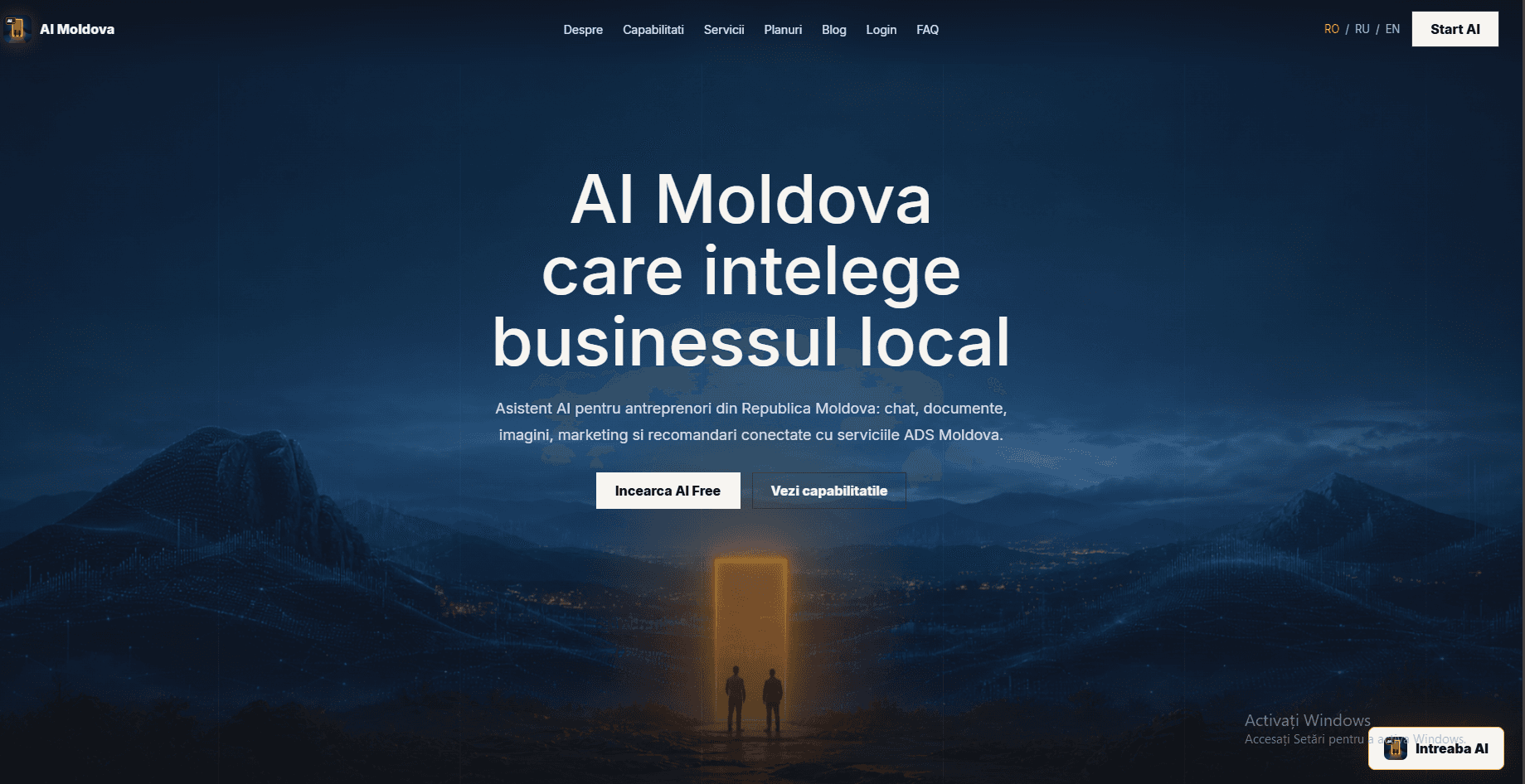
Premium landing page with cinematic visual identity
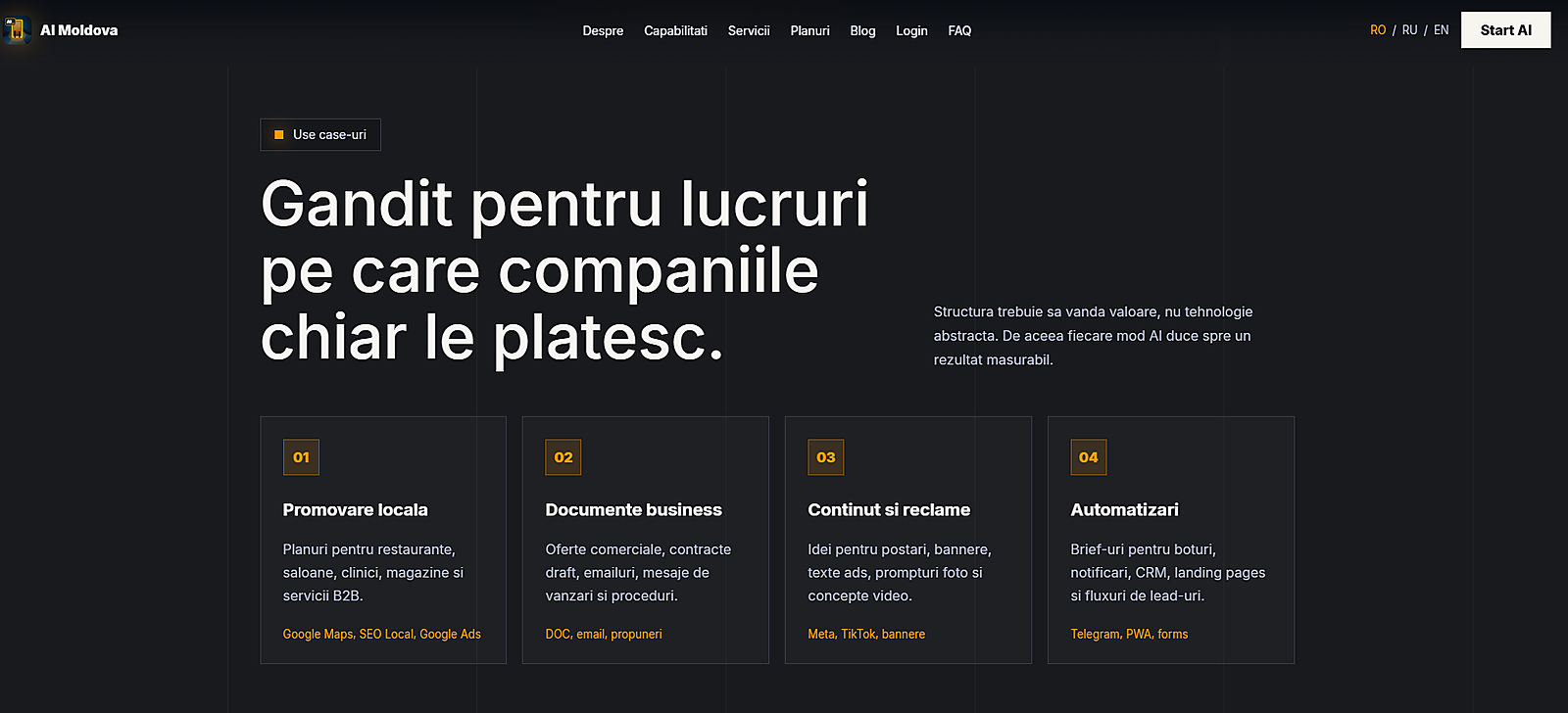
Workflows for consulting, documents, images and marketing
Multilingual RO/RU/EN structure
Capabilities, services, plans, blog and FAQ sections
Positioning as one of Moldova's first local AI products
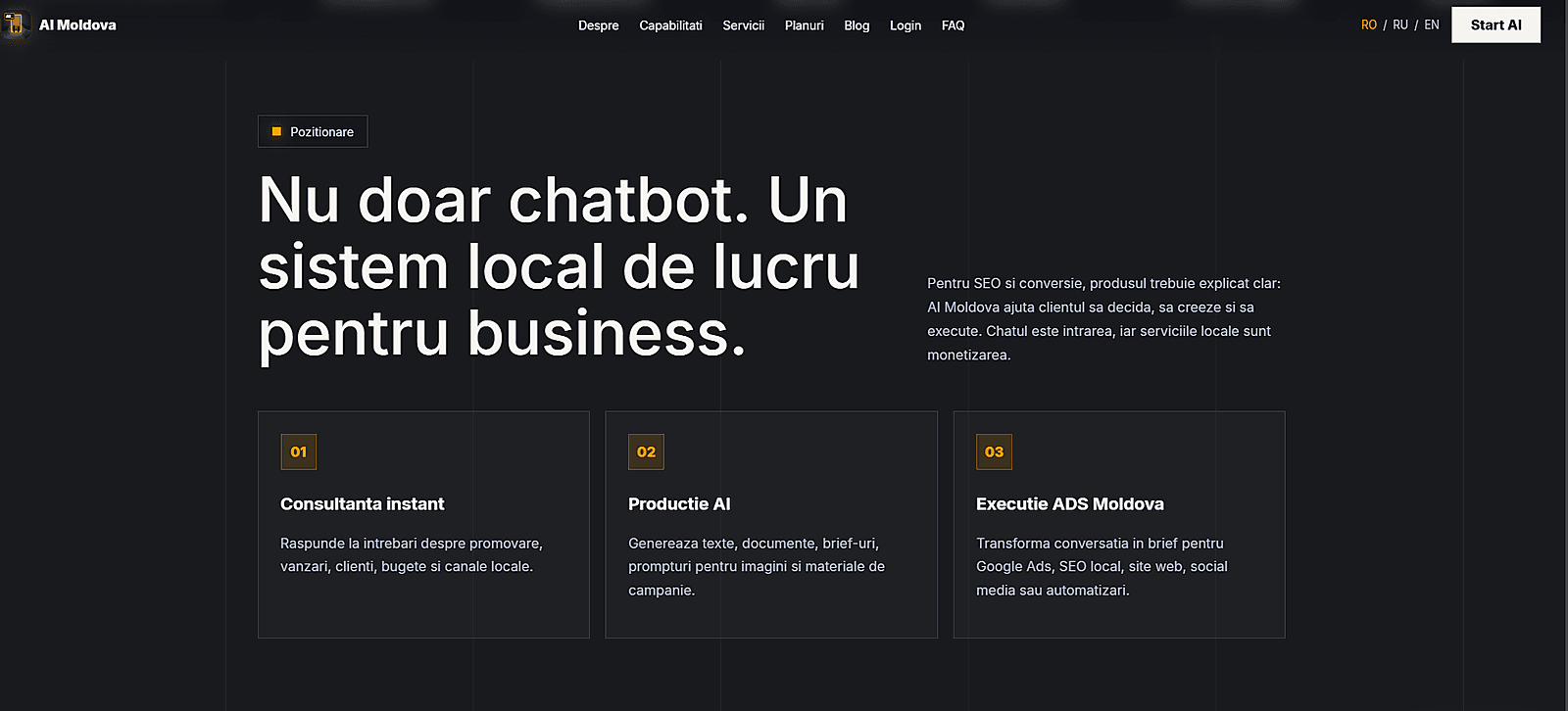
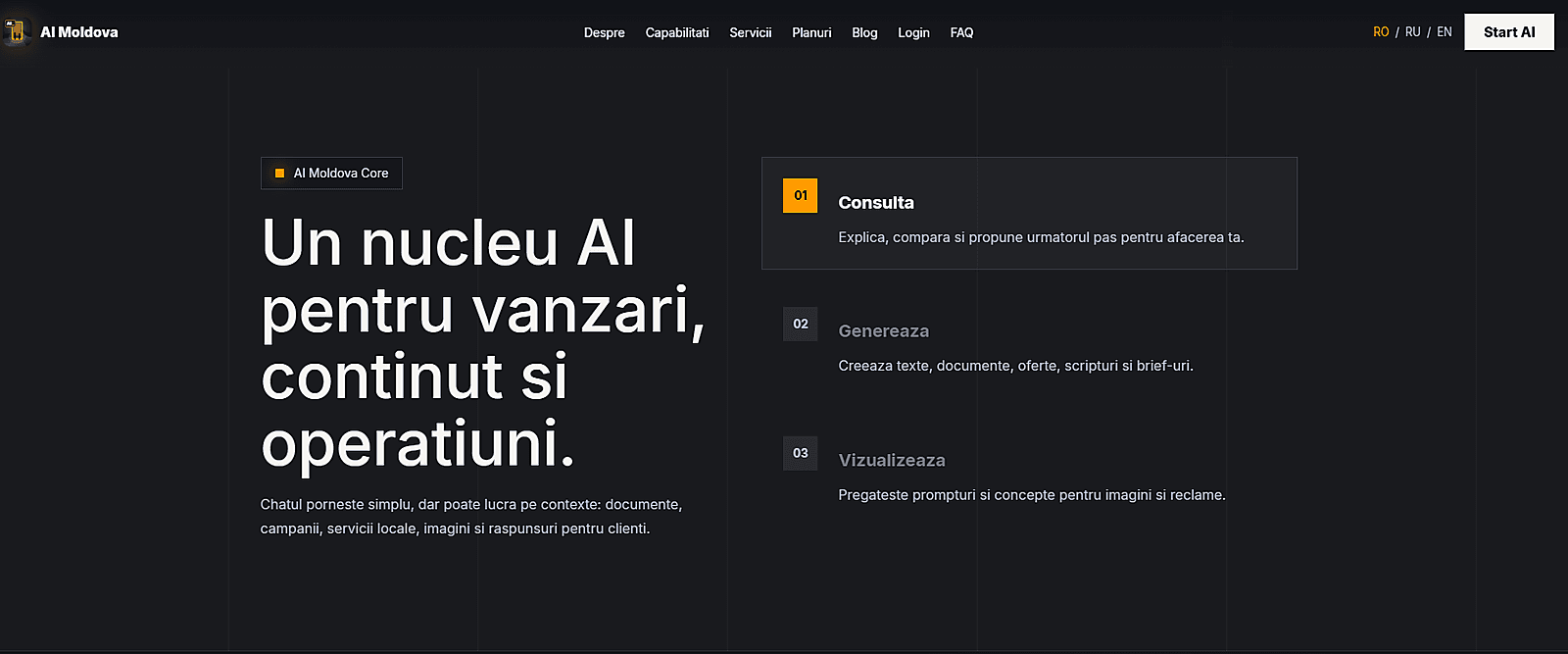
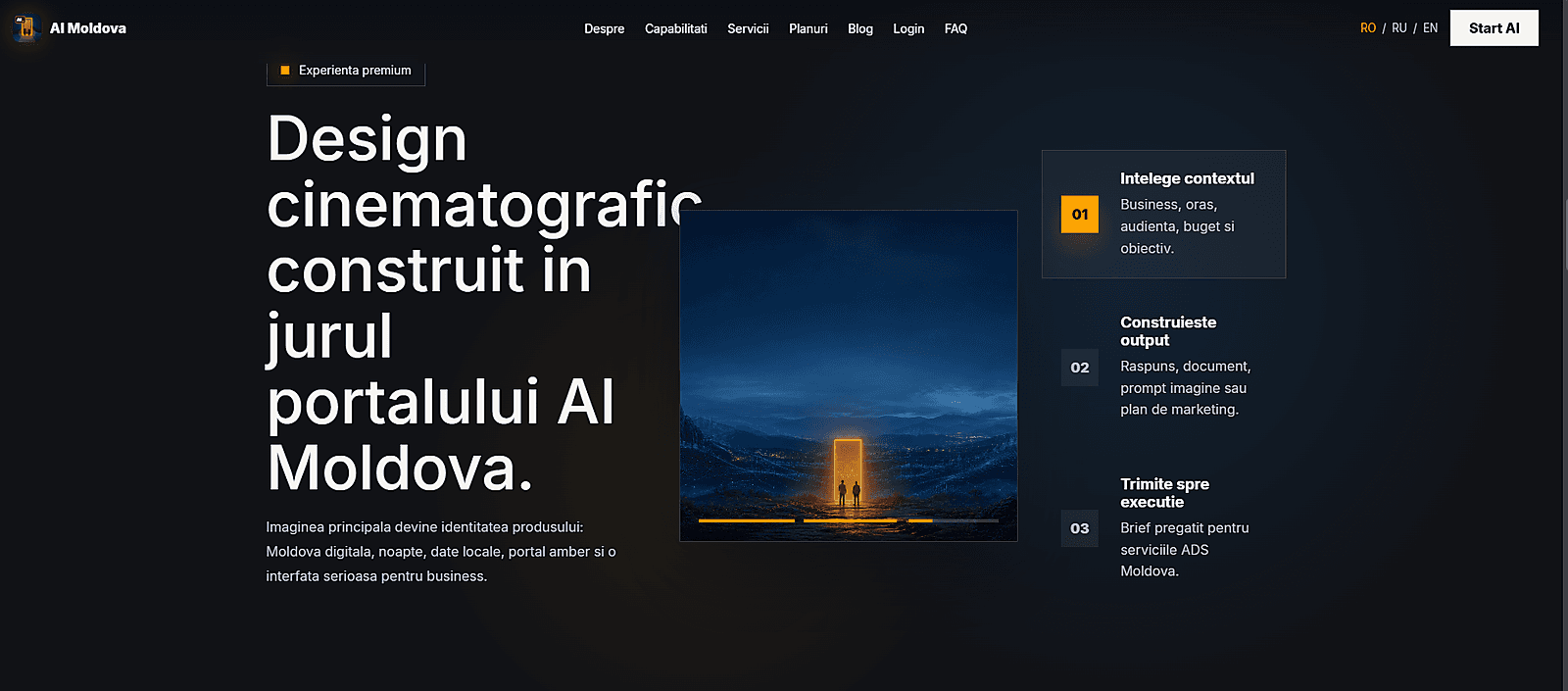
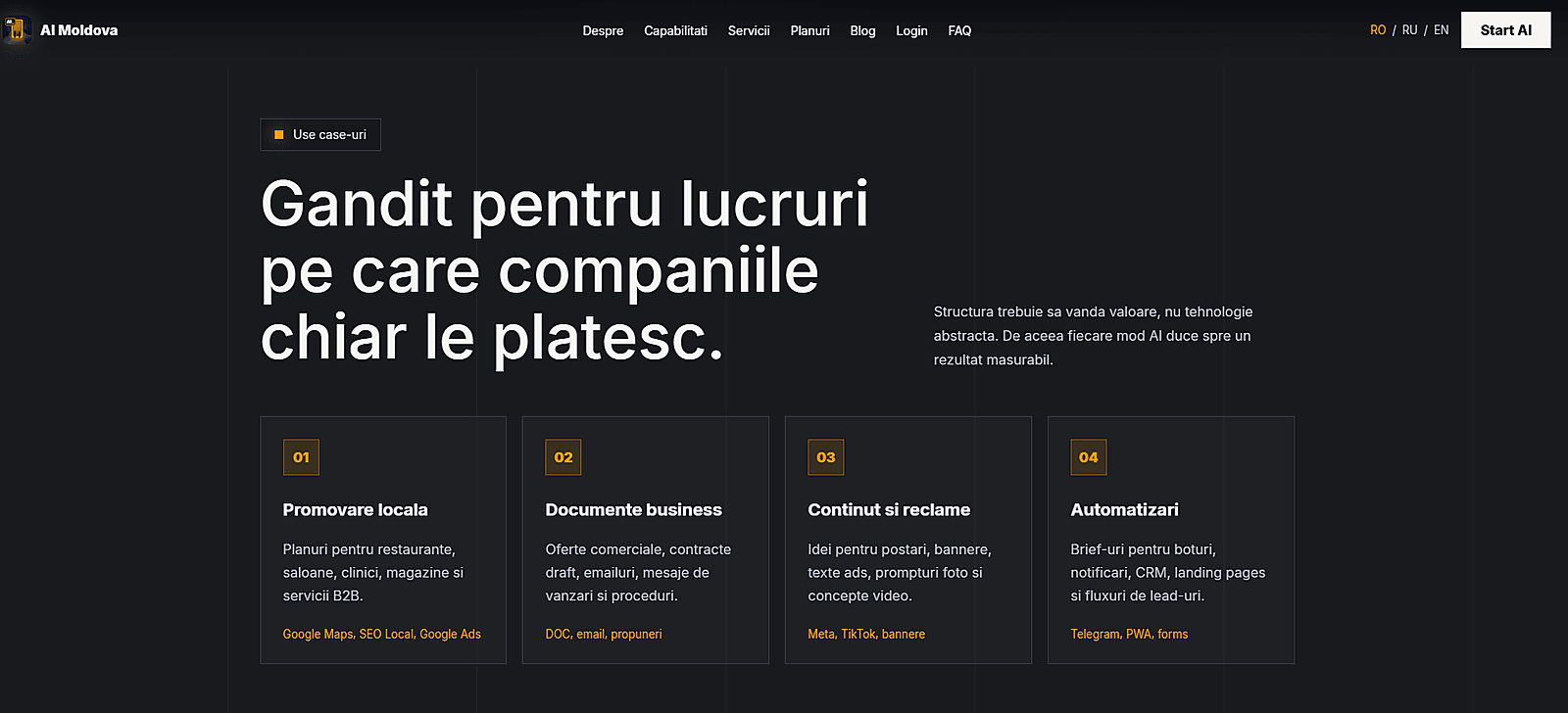

We can build an assistant, portal or AI system adapted to your industry and connected to marketing, lead generation and automations.
Extended case study
Local AI platform, PWA and service ecosystem. We examine the decisions that transformed the initial requirement into a usable product for entrepreneurs, small teams and companies from the Republic of Moldova.
Open AI Moldova01 · Executive summary
AI Moldova was built as a distinct digital product, connected to ADS Moldova's experience in strategy, advertising, websites, content and automation. The project does not just present a list of AI functions, but organizes a practical route: the user can start from a question, generate documents or visuals, analyze a business idea and continue with executable services. This link between consulting and implementation is the core of the product.
The project primarily serves entrepreneurs, small teams and companies from the Republic of Moldova, within the market context of Republic of Moldova, with interface in Romanian, Russian and English. The evaluation therefore goes beyond the visual appearance of the first page. A strong digital product must explain the offer, guide the user toward an appropriate action, keep information accessible on mobile devices, and remain manageable after launch. These criteria shaped the architecture, content, and implementation order.
The primary objective was to transform artificial intelligence from a general concept into a working tool accessible to local businesses. To achieve it, we treated the website as part of a system: public pages establish context, forms and actions capture intent, and the tools behind them organize follow-up. Every section therefore has a verifiable purpose. It does not merely fill space; it answers a real user question or removes an unnecessary step from the process.
02 · Context and strategy
There is interest in AI in the local market, but many international tools start from the assumption that the user already knows the terminology, patterns and how to set it up. The project was supposed to reduce this distance. We followed an experience where the language, examples and actions are close to the reality of a Moldovan business, and access from the phone is as important as using it from the desktop.
The first step was to separate mandatory requirements from ideas that could be added later. We mapped the audience, important actions, content types, languages, data requirements, and administration model. This analysis prevented the creation of an attractive page that would be difficult to extend. It also clarified what should remain public for indexing, what belongs in a private flow, and what information should be stored in the CRM or administration panel.
We separated the AI product from the agency site, but kept clear connections between them. AI Moldova has its own identity, navigation and offer, while ADS Moldova remains the implementation point for website, CRM, advertising, tracking and automation. Thus, the user can explore the product without commercial pressure, but find a concrete path when they need execution.
The strategy followed a simple order: users first understand where they are, then what they receive, why the solution is relevant, and what to do next. Trust elements were placed close to the decision instead of being hidden on a secondary page. Detailed information received its own level in the hierarchy, keeping the first screen focused while remaining available to people who compare offers carefully.
The structure groups functions by actual tasks: chat, documents, images, marketing, automations, and recommendations. Capabilities, Services, Plans and FAQ pages explain the product step by step. The chat interface keeps the central composer, conversations, and ways of working in a familiar structure, and public pages provide context before the user gets started.
Information architecture has been validated through trails, not just through a list of pages. I've been watching what happens if the visitor goes straight from Google to an inside page, comes back from his cell phone, or ends up in an ad with a precise intention. Each route maintains access to context, offer and contact without forcing the user to manually return to the main page.
03 · Implementation
Implementation was divided into modules with clear responsibilities. This approach reduces dependencies between pages, allows targeted updates, and helps the team test important functions without blocking the entire product. Visual components follow shared rules, while content and user journeys are adapted to the project instead of being copied mechanically from a template.
The main screen cuts through the noise and starts the conversation from real issues, not technical model names.
Indexable content explains what the product can do before logging in or opening a conversation.
The interface can be installed and used quickly from the phone, with controls adapted to the available space.
When a recommendation becomes a project, the user can go to ADS Moldova services without restarting the entire context.
At the technical level, we paid attention to intermediate states: loading, error, confirmation, empty results, and returning to an unfinished flow. These situations are common in real use even though they rarely appear in static mockups. Messages and controls were designed so users understand what happened and can continue without immediate support.
Content was treated as part of the product. Headings explain the decision at hand, paragraphs use concrete examples, and buttons clearly name the action. We avoided generic wording that promises a great deal without explaining the deliverable. In a case study, this clarity is as important as the technology because it shows what was implemented and why the solution fits the project's audience.
04 · Experience and Conversion
Conversion does not depend on a single form. The user can try chat, open a skill, consult a plan, or request deployment. Each route maintains the original intent and avoids the sudden jump from information to sale. For complex projects, contact becomes the natural continuation of an exploration already started.
The conversion route was designed around intent, not a single button. Early people need explanations and examples, while determined visitors seek price, contact or direct action. The page keeps both variants, but sets a clear visual priority. Secondary actions do not compete with the main action and contact remains accessible without aggressive windows.
The forms only require the data required for the relevant stage. An initial application should not be converted into a long questionnaire and an order should not be left without the information the team needs to reply to. Confirmation explains the next step and estimated time. This continuity reduces repeated messages and sends that the process is administered, not improvised after sending the form.
The product was treated as an app, not as a promotional page. Navigation, conversation panel, composer, and suggestion cards have distinct states for mobile. The PWA installation and basic cache provide quick access from the home screen without the more cumbersome process of an app distributed exclusively through stores.
On mobile, the order of content has been revised separately. I didn't just shrink the desktop version. Titles, images, buttons, lists and spaces have been reorganized for one-handed reading. Interactive areas have stable dimensions, the text is not hidden in rigid containers, and long sections retain visible landmarks. For individuals using keyboard or assistive technology, labels, hierarchy of titles and focus states retain the meaning of actions.
05 · Discovery and data
Public pages explicitly describe capabilities and use cases so that search engines can understand the product without relying on chat content. Titles, descriptions, links to services and information pages create thematic contexts for local AI, automation, documents, images and marketing in Moldova.
The search optimization starts with a structure that the user can understand. Each important page has a main subject, descriptive title, description and links to the pages that complement the intention. The images have stable dimensions and descriptive alternative texts, and the addresses of the pages are kept simple. Canonical, sitemap and rules for crawlers support the same architecture and avoid indexing technical states, filters or private pages.
Internal links are used editorially: they explain the relationship between the project and the services that made it possible. External links send to the public product and verified sources, allowing the reader to compare the description with the actual implementation. We don't use an artificial list of keywords. The context, correct names and verifiable information are more useful for both humans and search engines.
The measurement tracks chat entries, selecting a suggestion, opening capabilities, and moving to the implementation request. For an AI product, the mere number of visits is not enough; more important is if the user reaches a clear action and returns for a new task.
Measurement is defined before reporting. Visits, scrolls and clicks are user indicators, but they are not automatically a business result. For each project, actions that have value are tracked: requests, calls, orders, access to a function or return. Events are consistently referred to so that data can be compared between pages and periods without different manual interpretations from one relation to another.
The architecture is ready for extending models, responses, and tools without rebuilding public pages. Separation of data, interface, and flows allows for gradual product updates while maintaining a consistent experience and better control over costs and security.
The launch does not complete the project. It is necessary to check forms, update information, monitor errors, review dependencies and regularly control indexed pages. The roles and rights of access limit accidental changes and safety copies and history of changes reduce operational risk. A modular structure allows expansion without affecting routes that already operate.
These links provide additional technical context and describe the supplies used in implementation.
06 · Verifiable Gallery
The screenshots below document the project; they are not decorative images. Each one can be opened at a larger size to inspect the hierarchy, content, and interface details. The gallery is placed beside the technical explanation so readers can verify the connection between the decisions and the visible result.
07 · Conclusions
The most important conclusion is that a digital product should not be assessed as a collection of screens. Its value lies in the connection between the message, interaction, data, and the process that follows contact. For AI Moldova, this link was built from the specific needs of the segment entrepreneurs, small teams and companies from the Republic of Moldovawithout forcing the project into a universal structure.
The second conclusion is that visible simplicity requires work in architecture. For a user to see few clear choices, the system must manage pages, states, roles, content and measurement correctly. This complexity must not be transferred to the interface. It is organised behind and progressively revealed only when it becomes relevant.
The analysis was confronted with available public pages. The links below are provided for direct verification and additional editorial context.
08 · Frequently Asked Questions
Because AI Moldova serves entrepreneurs, small teams and companies from the Republic of Moldovaand this audience has its own path, language and confidence criteria. A template can speed up prototyping, but it cannot decide on its own what information to publish, what action is priority, how to keep the context between pages or how to measure the result. The final structure was built from the requirements of the project, then visually unified through reusable components.
The important flows have been reviewed at different sizes, carefully in the order of content, the size of the pressing areas, legibility, images and forms. The mobile is not a small copy of the desktop. Some elements change order, the lists are simplified and the main proceedings remain available without covering content or other checks.
It means that public pages have clear topics, titles and own descriptions, semantic hierarchy, descriptive images, internal links and stable addresses. The sitemap, canonicals and indexation rules support the same structure. SEO is not a promise of position, but the technical and editorial capacity of the site to be discovered, understood and evaluated correctly by search engines.
The modules are separated so that AI Moldova be able to receive new pages, functions, integrations and content without complete reconstruction. Expansion starts with user data and actual customer questions. New functions are prioritised by impact, dependency and cost of administration, not just by the fact that they can be technically added.
The availability of pages, errors, forms, relevant actions, speed and navigation behaviour shall be monitored. The data shall be interpreted in relation to the objective of the project. If a page attracts traffic, but does not lead to useful action, the message, information order and supply shall be reviewed before increasing the promotion budget.